Saturday, April 22, 2017

Mobile Ranking Factors 2017: Is Your SEO Mobile Friendly? – Search Engine Journal

After two decades of growth and development, mobile devices now bring the largest chunks of traffic to online businesses, and their influence is only going to expand further and further. That’s exactly the reason for Google’s switch to mobile-first: to open new possibilities in the art of website optimization. To seize them, we need to answer one question first: How does one improve website rankings with mobile SEO?

There are a number of factors which make your mobile website rank higher (or lower) in Google, and they can be safely divided into three major groups: technical, user experience and content. There’s an additional group for a few other factors that can’t be included into the previous three, but still deserve mention. To help you get better acquainted with them, the editorial team of WebCEO has composed this list below that describes the most important mobile ranking factors.

Technical Factors

Site Speed – GOOD

This will benefit your site.

Who doesn’t like fast-loading web pages? They are a treat regardless of what device you use to surf the net. However, users tend to show less patience than usual with handheld platforms.

According to a Mobile Ranking Factors study by Searchmetrics, the average loading time in the mobile top 10 is 1.10 seconds, and being only a tad slower (1.17 seconds on average) sends you further down in the top 30. The line separating successful sites from the poorly optimized ones is shockingly thin, wouldn’t you agree? By the way, if the site doesn’t load in 3 seconds, mobile users just close the browser’s tab.

AMP (Accelerated Mobile Pages) – GOOD

This will benefit your site.

AMP’s secret is being light on their HTML and CSS code. It makes pages easily pre-renderable and cacheable for browsers, and as a result, they load 30 times faster than regular pages – basically, almost as soon as you click on the link. Thanks to this neat ability, AMPs have a positive effect not only on rankings, but on click-through rates as well. No wonder they show up in almost every Google search result: after all, they offer the best of the best user experience.

Flash – BAD

This will drag your site down.

Perhaps this issue will be addressed later in the future, but for now, most mobile browsers don’t support Flash content and thus can’t display it. Which is why it’s best to have none on your mobile site. Otherwise, not only can users not see what you wanted to show them, but you also risk a penalty from Google for hidden content.

Technical Errors – BAD

This will drag your site down.

This goes without saying. A webmaster who allows errors and bugs on their site has no respect for themselves, their work or their users. This isn’t even a matter of ranking high in search results… though of course, that’s also a factor to consider.

If your site has issues that need fixing, users are most likely to run into errors such as faulty redirects leading to the site’s desktop version and non-existing pages (good old 404 errors). Small problems can turn exploring your website into one big problem, so don’t take too long dealing with them. And big problems that are already there demand even swifter action.

User Experience Factors

Unordered Lists – GOOD

This will benefit your site.

Who would’ve thought that something as ordinary and common as a list of whatever things could affect your site in a positive way?

Google seems to reward mobile sites for having unordered lists even more generously than desktop sites. This is not surprising because a neatly organized list is easy to scan. However, rankings begin to fall when the lists have too many elements in them. Because a small screen can display only so much at a time, the golden number of bullets for mobile devices is 9.

Images – GOOD

This will benefit your site.

A picture is worth a thousand words. This old saying holds water in web design, as well.

Apart from being aesthetically pleasing to the human eye, images are also easier to perceive and leave a stronger impression on the viewer than raw text. It’s not surprising at all that visual media are an integral part of creating an enjoyable site. However, one must not forget how abundant content affects the site’s loading speed. Optimize your images to reduce their dimensions and file size and avoid using too many. On average, a single mobile page has 4 images.

Intrusive Interstitials – BAD

This will drag your site down.

Pop-ups are the most hated enemy of all Internet users, desktop and mobile. They can be shameless enough on a PC even when they ask for something as innocent as your subscription – now imagine the same on a mobile device. Its much smaller screen makes it a lot easier to obstruct a site’s content with a single annoying pop-up form. Google knows this, and so they have rolled out an update that will smack the more selfish website owners with a good penalty in rankings. The algorithm still needs some work, but I hope you know better than to underestimate Google.

Small Font – BAD

This will drag your site down.

“What is this? A web page for ants?”

If you’ve ever tried opening a desktop site on a handheld device, you probably had trouble reading its contents. That’s to be expected when a page made for your standard PC display is shrunk to a mere 540×960 pixels. For that reason, the logical solution is to use large (recommended value is 16 pt.) font on your pages – at least above the fold. That’s where the page’s headline is placed, and that’s where it must serve its purpose to get the visitors invested in the content below.

Small Touch Elements – BAD

This will drag your site down.

Do you use interactive elements on your site, like buttons or checkboxes? They shouldn’t be so small that the user’s finger has trouble pressing on them. Imagine the frustration from trying to hit a pixel on a screen and missing ten times in a row. What do you think will happen to your conversion rates if visitors can’t fulfil their goal on your site?

Missing isn’t the worst-case scenario, though; it could get much more dramatic. If small elements are placed next to each other, the user might press the wrong one and end up posting his or her credit card information online for all to see! A bit extreme, but for an example, it brings the point across nicely.

Internal Links – BE CAREFUL

Mobile pages tend to have around 75% fewer links on them than desktop pages. This is due to the limitations placed on their size and content in order to improve UX. In a similar manner to other interactive elements, avoid placing the links too close to each other, as it’s too easy for a human digit to slip.

Content Factors

Keywords and Related Phrases in the Body – GOOD

This will benefit your site.

While keywords are still important, no web page is free from the risk of being over-optimized. SEO is like chocolate: too much can and will poison you! This works with keyword presence in your content, too.

And the rule of thumb is simple. The longer the text, the more keywords and related terms it’s likely to have naturally. But mobile sites normally have shorter texts, so it would be strange for them to have as many keywords and phrases. Avoid over-optimization and keep it natural for the amount of words you have.

Keywords in External Links – BAD

This will drag your site down.

Internet marketing is a dog-eat-dog kind of world. Even after doing your SEO perfectly, you can still trip over your own two feet and fall face down in the dirt.

If you know how backlinks work and what kind of advantage they provide, it should be easy to see how this could work against you. If you are aiming to rank higher for certain keywords, don’t help other websites rank for them by putting your keywords into the anchor text that links out to them. Google might interpret an outbound link with a valuable keyword in it as indicating a source that is more relevant to the page’s topic than your own site.

Word Count – BE CAREFUL

While desktop sites remain ahead of mobile ones in terms of how many words per page they use, the mobile sites’ word count appears to be growing little by little. Curiously, a higher number of words places you further away from the top position in rankings, but URLs ranked worse than the top 10 have roughly the same text length as in the top 3.

Setting aside the confusing statistics, you should try to make your content rich by the mobile screen’s standards rather than the desktop’s. Between 700 and 1000 words is plenty.

Additional Factors

Social Signals – GOOD

This will benefit your site.

Rich social engagement provides a ranking boost for a site regardless of the platform. Users browse social networks on mobile, too. There’s no reason why you shouldn’t use this to your advantage.

An average user spends about 30 minutes a day on Facebook alone. Over 77% of all content shared via mobile goes through messaging apps like Facebook Messenger and WhatsApp, making them an excellent platform for attracting visitors (through means such as newsletters, invitations or ad targeting). Don’t forget that social media’s primary purpose is communication, and communication equals feedback! You won’t find it in such abundance anywhere else.

Local Search Optimization – GOOD

This will benefit your site.

Local SEO is essential for every business with a brick-and-mortar location. Mobile devices can be taken anywhere with ease and thus are more often used for finding places (including places to shop). Putting these two facts together, mobile SEO will give your business an even stronger presence on the Web.

But you may get discouraged if you try to research the conversions. According to data from Q4 2016, desktop websites got a 26% cart conversion rate, while smartphones brought only 16%! What gives? Well, there’s a really simple explanation: it’s because the shoppers prefer to make purchases on a larger screen. They use a mobile device to find what they want and then switch to a desktop machine to enter payment information.

See how important it is to have a site tailored for each type of platform?

Are you ready to claim the top spot in mobile search results for yourself? Sign up for a 14-day free trial on WebCEO and check your website for over 20 mobile ranking factors right away!

Check your website against critical mobile ranking factors now!

The opinions expressed in this article are the sponsor’s own.

https://www.searchenginejournal.com/mobile-ranking-factors-2017-seo-mobile-friendly/194751/

On – 18 Apr, 2017 By WebCEO [Partner]


source https://andlocal.org/mobile-ranking-factors-2017-is-your-seo-mobile-friendly-search-engine-journal/


Content Marketers: Organic Traffic Is The Key Success Metric – Search Engine Journal

Content Marketers: Organic Traffic Is The Key Success Metric


SEJ STAFF

Danny Goodwin

  • 1.6K
    READS

Content ROI remains one of the biggest struggles for marketers. Usually that’s because marketers are creating content with no greater business goals or objectives in mind beyond creating more content to generate traffic and engagement.

Companies are spending an estimated $135 billion on content marketing every year. Marketers who are unable to demonstrate ROI might soon face struggles justifying a continued investment in content creation – especially considering that most content fails.

So how are content marketers measuring the success of the content they create? Organic traffic is the top content marketing metric of choice, according to a new survey from SEO software service provider Conductor.

SEO + Content = Better Together

It seems content and SEO teams are working well together. According to Conductor’s survey:

  • 35 percent said an SEO professional was part of the content team.
  • 45 percent said they work closely together with the SEO team.
  • 21 percent identify themselves as a hybrid content/SEO professional.
  • 92 percent agreed that understanding and executing SEO better will help them do their job more effectively.

This collaboration is great news, especially considering that most of today’s content jobs (e.g., content marketing specialists, content managers, content directors) require SEO skills.

Top 7 Content Success Metrics

While organic traffic was the favorite of marketers in this survey, it wasn’t the only metric. The full list:

  1. Organic traffic
  2. Leads
  3. Social engagement
  4. All traffic
  5. Time on site
  6. Revenue
  7. Transactions

Conductor surveyed 163 content marketers working at agencies as well as B2B, B2C, and publishing companies. Company sizes ranged from under 100 to more than 10,000 employees.

Check out Conductor’s full survey, Anatomy of the Modern Content Marketing Team, to see more insights on content team structure, leadership, and reporting.

Image Credit: Depositphotos

https://www.searchenginejournal.com/content-seo-measure-success/193123/

On – 04 Apr, 2017 By Danny Goodwin


source https://andlocal.org/content-marketers-organic-traffic-is-the-key-success-metric-search-engine-journal/

Why SEO Is Beating Out Social Media As The Go-To Digital Marketing Method | Miami Condos

Why SEO Is Beating Out Social Media As The Go-To Digital Marketing Method


Camp

Attracting new customers to your RV park or campground requires you become better acquainted with modern technology. Old-fashioned methods, while not entirely obsolete, are becoming less popular for their time-consuming nature and narrow results. When people want to know the best cabin locations for their family vacation or are curious about camping methods suit them best, it’s up to you to offer them information as efficiently as possible. SEO, an acronym for ‘search engine optimization’, is a fantastic method for reaching out to potential customers and helping them on their way to a memorable weekend.

How Does SEO Work?

Customers generally dislike intrusive advertisements. They prefer a more organic approach that still gives them the information they need to make a successful financial decision. Compared to flashy banners and expensive television advertisements, SEO methods use small, informative articles to reach out to customers as they browse. Due to the prevalence of search engines to access information, it’s unlikely SEO will fall out of favor any time soon.

How Is SEO Cheaper?

When you prepare a campground for camping participants, you likely are attempting to save money in the process. Inbound leads, such as those from SEO efforts, have been found to cost up to 60% less than outbound leads. SEO leads also have a 14% close rate, compared to outbound leads (such as those from direct mail or print advertising) barely reaching 2%. Despite this lower cost, SEO has been found to pull in impressive revenue for small and large businesses alike.

Why Do Customers Prefer SEO?

SEO is generally preferred by customers for its convenience and accuracy. Google alone processes over one trillion searches on a yearly basis, based on the 100 billion searches conducted every month on a variety of topics and requests. Between 80% and 90% of customers prefer to check online reviews and comments before committing to a purchase, which can include camping offerings and resources.

How Does Social Media Help?

Social media is a wonderful way of connecting with your clientele as well as updating them on any new events or specials you have for your company. A study conducted by Outbrain showed that, despite social media’s success, SEO still beats out the average social media account by 300%. Overall, SEO is the number one driver of traffic to ongoing content sites and blogs.

How Can I Use Digital Marketing To Further My Brand?

Tourism website design should be one of the most important aspects of your camping business. Camping websites should be easy to navigate for new customers and repeat visitors. Tourism marketing is designed to be as appealing as possible, with detailed photos showing off the layout of the cabins and simple lists helping people decide whether or not their budget matches. Studies have shown over 40% of shoppers will start with a search engine, making SEO the best way to bridge the gap between your campgrounds and new families. Consider adding SEO to your marketing repertoire and see the changes overnight.

http://miamicondos.tv/why-seo-is-beating-out-social-media-as-the-go-to-digital-marketing-method/

On – 19 Apr, 2017 By Travel Tips


source https://andlocal.org/why-seo-is-beating-out-social-media-as-the-go-to-digital-marketing-method-miami-condos/

Friday, April 21, 2017

3 Extremely Profitable Types of Facebook Ads | Social Media Today

If you haven’t explored the power of Facebook advertising recently, you’ll be pleasantly surprised with the depth of their product offering. The platform is much more than boosting posts and buying likes.

Think about it – other than the NSA, who has more data on you than Facebook? They know what websites you visit, who you work for, where you grew up, your favorite football team – there’s an endless amount of data open to advertisers.

So if you’re still just boosting posts, you’re leaving some of the lowest hanging fruit in the orchard. To really turbo charge your Facebook advertising, try these three Facebook ad campaigns. They’re sure to boost your marketing efforts. After you watch the video, you can get a deeper look into each of our favorite types of Facebook advertising below.

1. Facebook Retargeting Ads

Retargeting is one of the most underutilized ad practices – in fact, 46% of marketers believe that retargeting is the most underused online marketing technology. The good news is that Facebook makes things easy. All you have to do is set up a retargeting pixel on your website, get some web traffic to your site, and start advertising to your past visitors.

Website visitors who are retargeted with display ads are 70% more likely to convert on your website. Let that number sink in.

If you’re saying to yourself right now, “Yeah, but Justin. There are tons of other places on the web I can run retargeting ads. Why Facebook?”

Here’s why:

  • Click through rates are 21X higher with Facebook News Feed retargeting than with standard retargeting.
  • Cost Per Click is 79% lower with Facebook retargeting than with standard retargeting. 
  • Cost Per Acquisition is 63% lower with Facebook retargeting than with standard retargeting.

It’s a game changer – honestly, don’t go one more day without a retargeting pixel installed on your website. 

2. Custom Audiences

There are lots of Custom Audiences you can set up within Facebook, but if you’re new to Facebook ads, there’s definitely one type you should start with.

Most businesses have an email list, but not all know how it can be used on Facebook. If you’re sending out emails to your list (whether it be a newsletter or product offering), you’re probably seeing between a 15% and 30% open rate. That’s leaving a majority of people who’ve subscribed to your list in the dark – not good.

If you want to get in front of more of those people, you can use Custom Audiences to do that. Remember, these are people who’ve already shown an interest in your product or service by signing up for your email list, which makes them a highly desirable audience to get in front of.

Upload your email list as a Custom Audience, and Facebook will automatically find users associated with those email addresses. It’s simple and highly profitable.

3. Dark Posts

Don’t worry, it’s not as scary as it sounds.

A ‘dark post‘ is a term used to describe Facebook posts that are paid but don’t show up directly on your Page. You get to choose (through targeting) who sees these posts, and when.

Not only can you get hyper-targeted with these posts, but you can also use them to gain insight into what will work organically on your page – you can A/B test and let your results guide your organic social strategy with your findings. This tactic is extremely valuable as it enables you to improve and present your best content to your most important audience – people that have already connected with you on Facebook.

http://www.socialmediatoday.com/marketing/3-extremely-profitable-types-facebook-ads

On – 22 Mar, 2017 By Cavejustin


source https://andlocal.org/3-extremely-profitable-types-of-facebook-ads-social-media-today/

How to Set Up an Effective Facebook Ad Campaign : Social Media Examiner

http://www.socialmediaexaminer.com/how-to-set-up-an-effective-facebook-ad-campaign/

On – 05 Apr, 2017 By Charlie Lawrance


source https://andlocal.org/how-to-set-up-an-effective-facebook-ad-campaign-social-media-examiner/

Wednesday, April 19, 2017

Article – Local SEO: 7 Questions by Kelly Shelton

Proximity, The Number 1 Local SEO Ranking Sub-Factor – Local SEO Guide

The 2017 Local Search Ranking Factors, a survey of Local SEO professionals on what they think it takes to rank in local search, was just released at MozCon Local/Local U. Andrew and I both love participating in the survey, as it’s a chance to see what the Local SEO hive mind is thinking. I highly recommend checking it out to see how people are thinking about local search rankings.

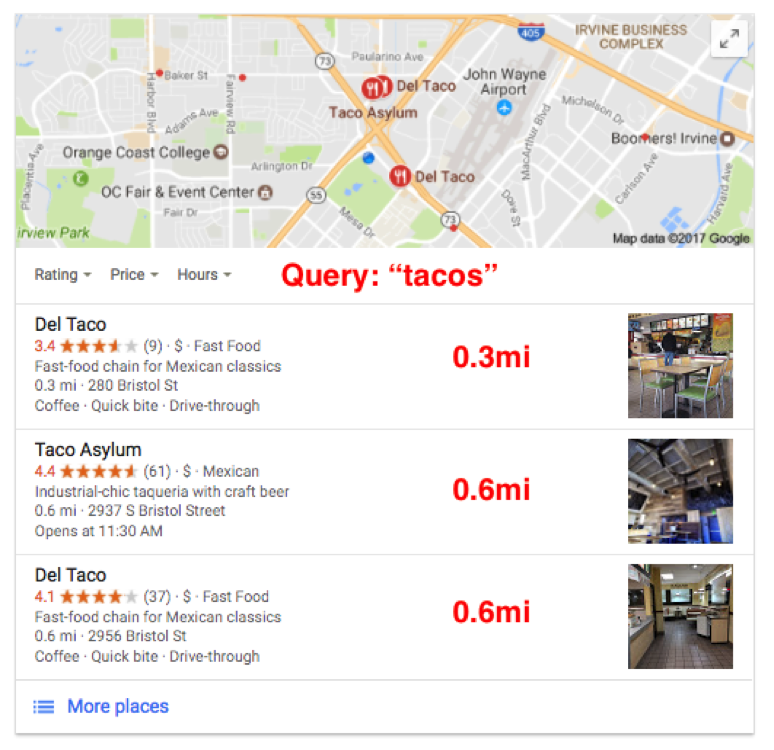
Coming out of the 2017 version, the talk of the town is on Proximity (the distance between a user and a business) as the ‘#1 ranking factor’. Given the way local packs look, I totally get this. Proximity is massive. Just look at these Local Packs:

Pet Store Local Pack 

Taco Local Pack

Let’s all shut it down, folks. Local SEO is dead! Just keep moving your biz and you will be #1 for all customers!

Move your business

Calm down, I promise we are going to be okay. I’m not going to tell you your own eyes are wrong, Packs look like they are almost exclusively ordered by user proximity (with some occasional tie-breaking factors like reviews).

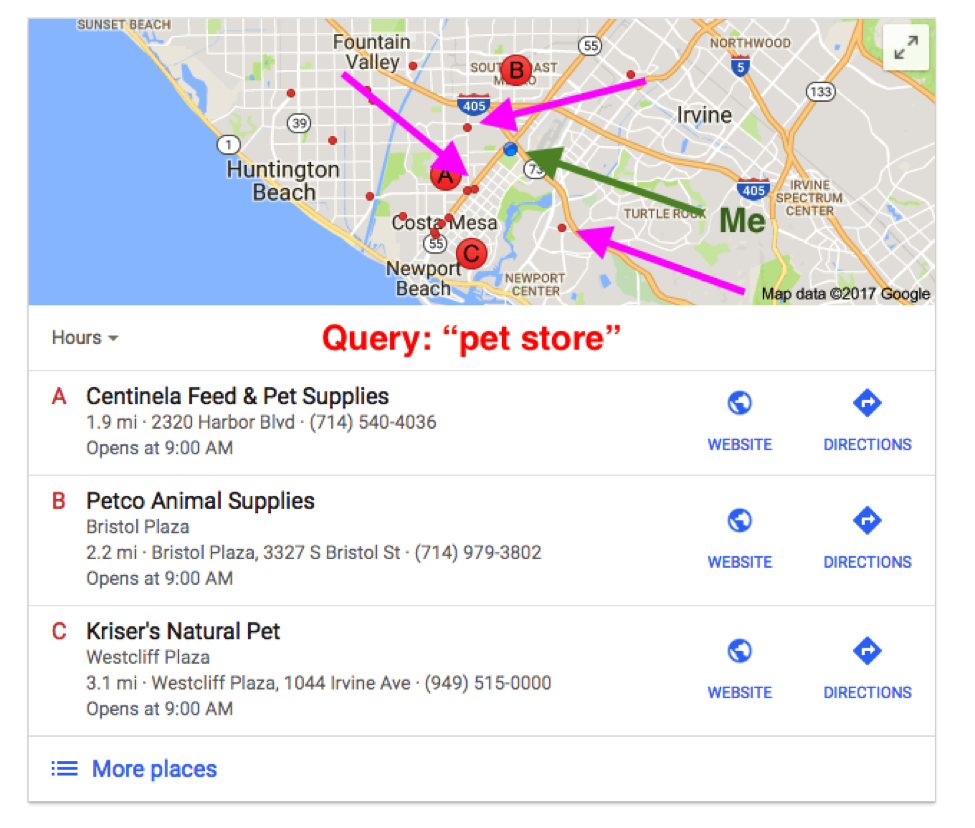
But, remember, those aren’t the only available businesses to show in a pack. Check out the same SERP with other businesses and my location annotated:

Annotated Pet Store Local Pack

The green arrow & text is where I’m located and the purple arrows are all locations that are physically closer than the locations that are showing up in the Local Pack. This means that Proximity can’t be an overriding factor in terms of ordering businesses.

This makes perfect sense to me.

Often, there are more relevant and prominent businesses then Google can display in a Pack/Local Finder, and if they were to just rank by Proximity then the results could very well be bad businesses near you. Google knows this, which is why it isn’t happening this way.

So to me, Proximity is the #1 local ranking factor like RankBrain is the #1 organic ranking factor. Yes, it plays a role in almost all searches, but I don’t think it’s usually the main thing getting you into most local packs.

Here is a great example where proximity is clearly not the deciding factor:

Coffee Local Pack

As you can see, Starbucks is easily the closest coffee business near me. It is specifically closer than Coffee Nature (the top result) and yet it doesn’t even crack the top 5. Clearly, there are other factors at play here.

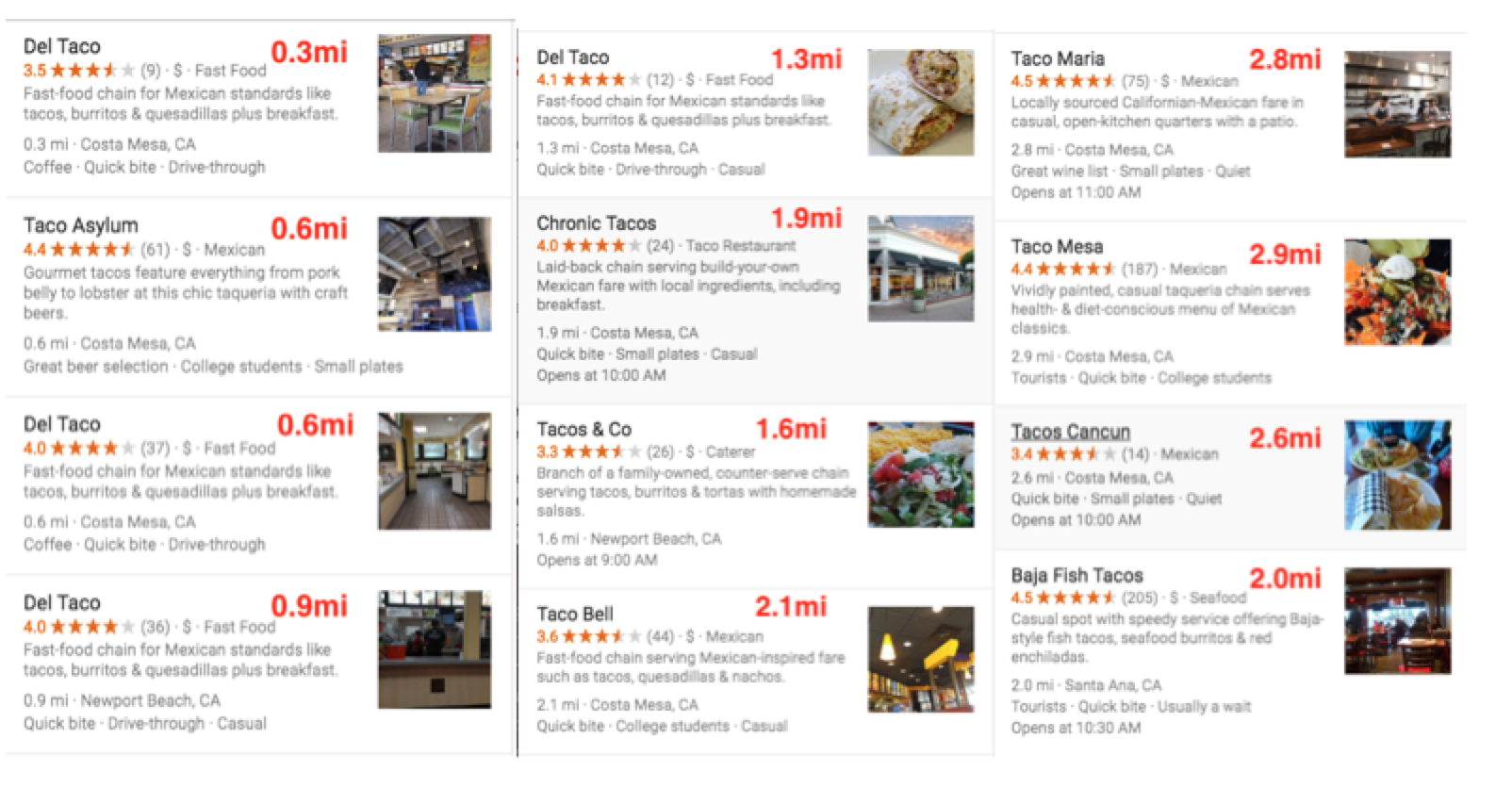
Let’s come at this from a different way. I did a search for tacos, then went to “more places” in the pack. Check out these results:

Local Results Annotated By Distance

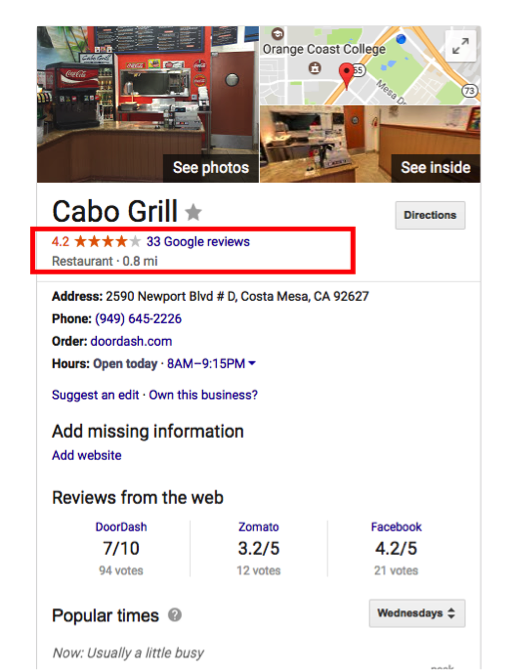
These results are not in order of closest to furthest. The top results are, but what determines which business are in those are the top results? It’s certainly not just proximity, just check out the case of poor Cabo Grill. The are totally left out of the top results even though, looking at proximity, it should be # 4 (it even has a good review profile!):

Cabo Grill Left Out Of Local Pack

You know what it doesn’t have? A website. Pretty hard to have dominating prominence and relevance without a website in 2017. But wait, there is more. Check out Fresca’s Mexican Grill. Should be #2 by proximity, but it doesn’t even crack the top 12:

Proximity not working for Fresca's Mexican Grill

Likely because unlike all the other examples it doesn’t have “taco” in the business name. That means relevance can override proximity.

One last piece, the weight of something like proximity is also dependent on the type of query. For local searches there are 2 types of queries:

Implicit Geo Location – “tacos”

Explicit Geo Location – “tacos costa mesa” & “costa mesa tacos”

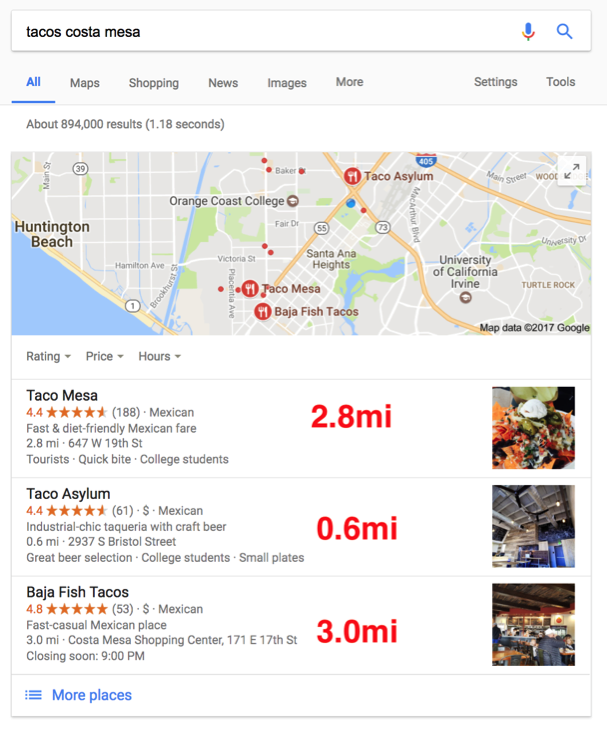
All the example I have shown have been with implicit geo-location. Check out the ordering of explicit geo-location queries on a desktop for “tacos costa mesa”:

Explicit Geo Location Local Query

It’s radically different from the implicit geo-location searches, and the proximity from my location matters much much less.

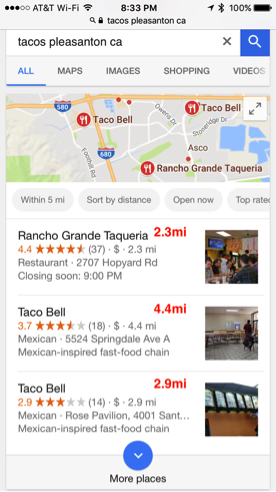
But Dan, maybe Costa Mesa is some weird vortex. Also, what about mobile?

I’m so glad you asked:

Mobile Local Search in Pleasanton

This search was conducted from Pleasanton CA, on an iPhone.

I feel pretty confident saying that Proximity matters much more with implicit geo-location searches. This is what we saw in our own ranking factor data as well.

I’ve been talking through this with lots of others in the Local SEO space. Darren Shaw is one of those people. I asked him to weigh in on this post and here are his thoughts:

“While Proximity to Searcher is one of the strongest factors in local pack results today (if not the strongest), it’s far from the only factor. There is still plenty of opportunity to improve your rankings by increasing relevancy and prominence through traditional local search work.”

I agree with what Darren is saying here. While I feel like I have made the case that Proximity is not the #1 ranking factor, it clearly plays a large role in how local search functions. That doesn’t mean you have to give up,  traditional prominence and relevance signals matter just as much, if not more, then proximity. Speaking of…

The #1 Local SEO Ranking Factors are Relevance, Prominence & Proximity

I think there is only one conclusion; there are other factors that determine what businesses are in which buckets, or even better that there are factors that determine which sub-set of results that Google is then going to order by proximity. Those are things like traditional relevance and prominence signals. Things such as keywords in the business name, links, reviews, and others that you would typically expect to influence search results. If you are in for a refresher course, check out the 2016 Local SEO Ranking Factors to see what the data says.

So basically, like in most things, Mike Blumenthal is right.

Mike Blumenthal is Right Tweet 1

Mike Blumenthal is Right Tweet 2

So maybe we should stop talking about internal position within a local Pack for a bit because that is more about the user and less about the business. Instead, we should talk about “PackRank(™)”, because if you are in a Local Pack then you are probably showing up #1 to some users (based on proximity).

Remember, there are numerous business categories where users aren’t looking to find service half a mile closer (like attorneys, doctors, CPA’s, car dealers etc.). In the Proximity Mine Pack this is where things like reviews can drive a higher CTR. Though this could be a pretty big negative to the foodservice industry. Most people aren’t always looking to drive a couple miles for that single origin flat white or a truly excellent taco.

One final thing before I go. When it comes to prominence, relevance, and proximity what do you think is the most important type of local search ranking factor. Please fill out this quick survey and let me know!


http://www.localseoguide.com/proximity-number-1-local-seo-ranking-sub-factor/

On – 21 Mar, 2017 By Dan Leibson


source https://andlocal.org/proximity-the-number-1-local-seo-ranking-sub-factor-local-seo-guide/